
From Celebrated Officer to Architect of Organized Crime
The most notorious and fully documented corruption case in the history of the Oslo Police one that more than any other exposed the spectrum of institutional complicity between law enforcement and organized crime was the case of officer Eirik Jensen. A man who rose rapidly through the ranks of the Norwegian police, Jensen was for years portrayed as a celebrated figure in the fight against organized gangs in the capital. Yet, at the most critical moment, he became a symbol of an internal conflict between the rule of law and private interest.
A Decade of Collusion: Intelligence Leaks, Smuggling Networks, and Systemic Blind Spots
According to the prosecution, Jensen actively contributed over nearly a decade, between 2004 and 2013 to the smuggling of approximately 13.9 tons of cannabis into Norway through a complex and tightly coordinated network of traffickers. The central figure in that network was Gjermund Cappelen, the main smuggler, who ultimately confessed before the court and became a key witness against his former partner.
Investigations established that Jensen’s role went far beyond intelligence gathering. He supplied traffickers with highly sensitive information regarding police patrol movements, inspection points, and customs surveillance operations. The Oslo District Court presented extensive evidence, including more than 1,500 encrypted text messages exchanged between Jensen and Cappelen. These messages repeatedly used coded language such as references to “weather conditions” to signal periods of weak inspections or reduced enforcement capacity, all in exchange for financial compensation and material benefits.
The acts attributed to Jensen included:
- Leaking confidential information about police and customs patrol schedules, locations, and operational readiness, enabling traffickers to move drugs across borders with minimal risk.
- Accepting bribes estimated at 2.44 million Norwegian kroner, in addition to other material benefits, including the renovation of his home valued at several hundred thousand kroner and luxury watches, as documented in the court’s ruling.
- Maintaining long-term, structured communication with traffickers through coded messages, demonstrating systematic coordination rather than incidental contact related to undercover work.
In its 2017 judgment, the court described the case as “unprecedented in Norwegian criminal law,” emphasizing that a senior police officer had not merely failed to combat crime, but had actively facilitated it over many years. The ruling underscored the profound damage this conduct inflicted on public trust in the very institutions tasked with enforcing the law.
Throughout the proceedings and even after the verdict Jensen consistently maintained his innocence. He claimed that all communication with Cappelen fell within the scope of “ordinary police work” involving a confidential informant, arguing that the text messages reflected routine information exchanges intended to gather intelligence. He denied receiving money or personal benefits, and his legal team repeatedly asserted that the prosecution failed to establish a direct causal link between the communications and criminal conduct.
However, the Court of Appeal, after reexamining the evidence, upheld the same sentence: 21 years in prison, the maximum penalty under Norwegian law. The court concluded that Jensen’s actions were deliberate, sustained over time, and constituted a serious threat to public confidence in the legal system he was sworn to protect.
Institutional Silence and the Collapse of Internal Oversight in Oslo Police
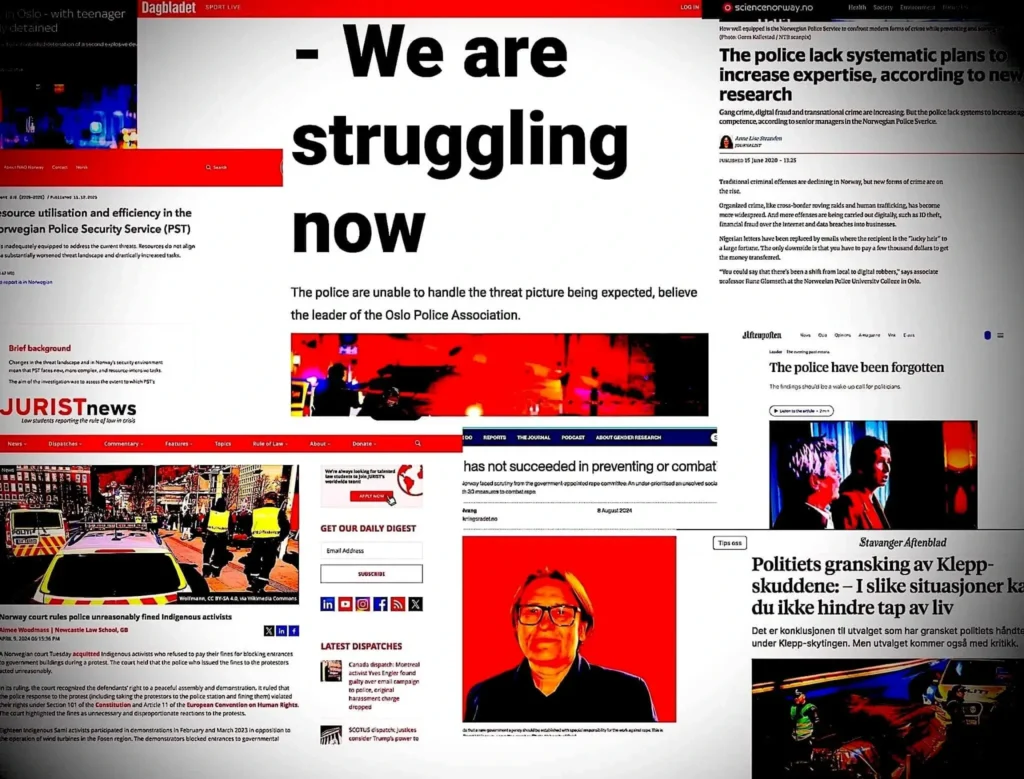
This case, weighed down by overwhelming evidence, cannot be reduced to the misconduct of a single officer, regardless of rank. Rather, it exposes the fragility of internal oversight mechanisms within the Oslo Police and their chronic failure to detect warning signs in a timely manner. That a senior officer was able, for years, to operate beyond internal control frameworks, breach informant-handling rules, and exchange sensitive information without effective accountability only to be stopped after nearly 13.9 tons of cannabis had entered the country points not to individual failure, but to accumulated institutional silence and administrative tolerance of misconduct, so long as it was masked by apparent operational “results” that satisfied leadership.
More troubling still is that this failure was not met with early acknowledgment or transparent review. Accountability mechanisms were activated only when corruption reached a level that could no longer be legally denied or publicly contained. Oversight did not function as a preventive safeguard, but as a forced response to a scandal that had already erupted, severely shaking public confidence.
In this sense, the Jensen case reveals more than a betrayal of oath by one officer. It lays bare an institution that prioritized reputation and short-term outcomes over internal discipline, allowing vast gray zones to persist until they crystallized into a fully developed criminal enterprise. It is a moment that exposes the limits of accountability within a security apparatus tasked with protecting the law yet slow to protect it, even from within.
“The corruption was not the act of a single officer, but the full institutional fragility of the Oslo Police was exposed: a security apparatus unable to protect the law even from within, silent in the face of years of violations, and designed to prioritize the appearance of competence over truth. What occurred was not an individual failure, but a systemic scandal proving that public trust in authority can be hijacked from within.”
Sources: