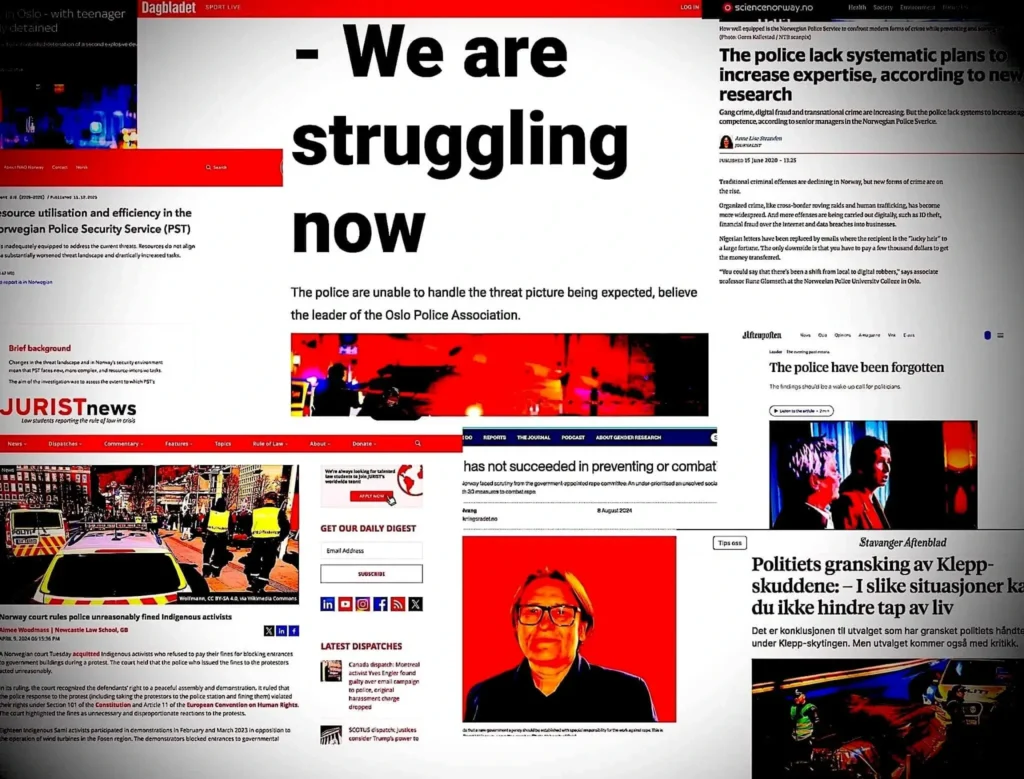

In one of the most serious arenas of organized crime within the Schengen area, recent international reporting does not question Norway’s legal framework on human trafficking. Instead, it highlights a widening gap between statutory commitments and measurable enforcement outcomes a gap that becomes particularly visible within policing structures in Oslo.
The U.S. Department of State Traffickingin Persons Reports (2024 and 2025) do not accuse the Norwegian state of ignoring human trafficking. What they document is more structural: a multi year decline in investigations, prosecutions, and convictions under the trafficking statute. The 2024 report records a noticeable reduction in trafficking cases investigated compared to previous years, while the 2025 update confirms one of the lowest investigative levels in nearly two decades.
This pattern is not described as political interference. Rather, the reports show that complex trafficking cases particularly labor exploitation cases requiring sustained evidentiary work frequently struggle to advance through the system. The practical effect is measurable: complexity correlates with fewer prosecutions and diminished judicial outcomes.
Importantly, the reports do not record investigations or convictions of government officials for trafficking offenses during the reporting periods. They also note that authorities often pursue suspects under lesser criminal statutes instead of the dedicated trafficking provision. The cumulative result is a gradual dilution of trafficking’s legal and investigative weight.
Resource Allocation and Institutional Priorities
The reports further document the reallocation of specialized anti-trafficking personnel to other duties within law enforcement structures. While no motive is attributed, the institutional consequence is clear: reduced investigative focus and weakened capacity to identify victims systematically.
When specialized expertise is not institutionally anchored, enforcement becomes episodic rather than coordinated. The reports point to gaps in training, victim identification procedures, and sustained expertise retention. In practical terms, this creates structural fragility rather than operational resilience.
Norwegian law provides penalties of up to ten years’ imprisonment for trafficking offenses. The contradiction lies not in legislation, but in enforcement metrics. When severe statutory penalties coexist with historically low investigative levels, the discrepancy becomes institutional rather than incidental.
Structural Diagnosis from Academic and European Monitoring
Academic research from Norwegian police studies reinforces this institutional diagnosis. Findings indicate insufficient specialized expertise in trafficking cases and a reliance on victim testimony rather than proactive, intelligence driven dismantling of organized networks. Investigations become slow, fragmented, and vulnerable to disruption.
European monitoring reports over the past decade identify another recurring issue: trafficking cases are at times downgraded into lesser offenses such as labor violations or documentation irregularities. This procedural reclassification reduces the organized crime dimension of trafficking and limits the systemic impact of enforcement.
The Institutional Question
No international report accuses the Oslo Police of direct complicity. The concern emerging from the data is more systemic and more consequential. The enforcement architecture appears reactive, resource constrained, and statistically diminished relative to the scale and severity of the crime it is mandated to confront.
The erosion is not declarative; it is statistical.
It is visible not in public statements, but in investigative volume, prosecutorial outcomes, and resource allocation.
In this gap between law and enforcement, trafficking networks operate within a narrowed field of institutional pressure while victims remain dependent on a system that formally condemns the crime yet increasingly struggles to pursue it with consistent intensity.
Sources:
https://www.ecoi.net/en/document/2111736.html
https://www.ecoi.net/en/document/2130651.html
https://phs.brage.unit.no/phs-xmlui/handle/11250/297965