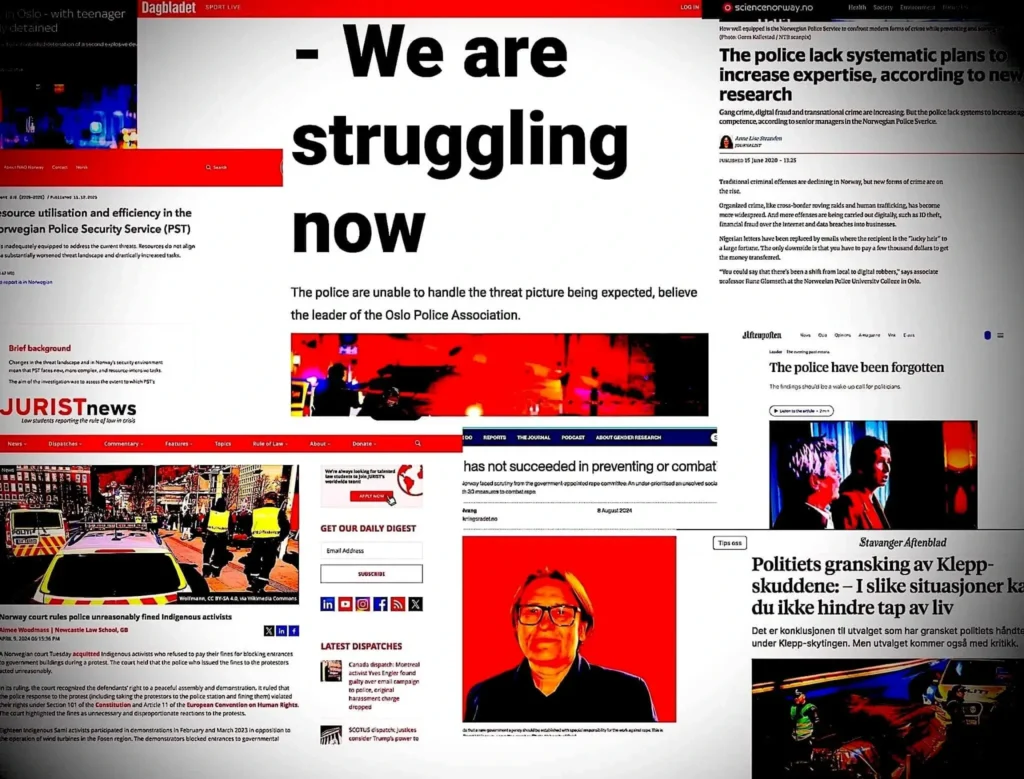

A Broken Shield
In late December 2025, an opinion survey celebrated by the leadership of the Oslo Police District suggested that a large majority of residents continued to express confidence in the police. For the Police Chief, the result was presented as reassuring evidence that public trust in law enforcement remained intact.
Yet opinion and reality do not always move in the same direction.
Public confidence may persist even as institutions erode; it does not necessarily reflect real strength as much as it echoes a legacy of reputation and the absence of viable alternatives. When the state monopolizes the function of protection, trust endures less as an informed evaluation of performance and more as an expression of the need for order.
This tendency is reinforced by the social fabric of Norway, where trust in others and respect for institutions are deeply embedded norms. The nomination of an individual with a concealed criminal past to a public position in the Fredrikstad City Council illustrates how trust can, at times, rest on assumed integrity rather than verified accountability.
For decades, Oslo has been portrayed internationally as a model of Nordic safety and social stability. The city’s institutions, its policing culture, and its reputation for order have long served as symbols of a well functioning justice system.
Yet beneath this carefully sustained image, a more complex reality has begun to surface.
Recent developments reveal a deepening challenge within the capital’s law enforcement not merely in managing street-level crime, but in the very capacity of the Oslo Police District to confront sophisticated criminal networks operating both domestically and across borders.
Disclosures from senior officials now confirm that the city faces a systemic challenge from organized crime one that raises difficult questions about institutional capacity, strategic oversight, and whether the reputation of security in Oslo still reflects reality on the ground.
120 Criminal Networks and an Overstretched Force
In December 2025, Oslo Police Chief Ida Melbo Øystese publicly revealed a startling figure: over 120 criminal networks involving approximately 800 individuals are actively operating in Oslo. These groups span a wide range of illicit activities including drug trafficking, weapons distribution, and violent enforcement and have embedded themselves deeply into urban neighborhoods.
This unprecedented number reflects a sharp escalation of organized crime that traditional policing strategies have struggled to contain. These are not isolated gangs or spontaneous outbreaks of violence, but an entrenched underworld with extensive social reach.
Violence, Murder Conspiracies, and Criminal Conflicts
In late November 2025, Oslo police detained four men accused of conspiracy to commit murder in connection with ongoing criminal network conflicts. According to official statements, the case was not random, but directly linked to escalating gang related violence in the city.
Such conspiracies underscore the volatility within organized crime circles and demonstrate that these networks are not merely economic actors, but entities engaged in planning lethal operations that threaten public safety and social order.
Transnational Crime and Cross-Border Operations
Oslo’s organized crime landscape is not confined within national borders. In mid 2025, joint operations between Turkish and Norwegian authorities led to coordinated arrests in drug trafficking cases linked to the city, resulting in the seizure of hundreds of kilograms of narcotics and revealing the cross-border reach of criminal networks.
On the other hand, the Oslo Police face a profound challenge from internal infiltration. Documented reports indicate the involvement of some officers in supporting human trafficking networks, including a 2022 case in which an individual responsible for smuggling dozens of migrants into Schengen countries received legal support and protection from Oslo Police after residing in a police officer’s home, later being used to blackmail victims. Reports also emerged of journalists being blackmailed after documenting and publishing violations involving police personnel, reflecting internal oversight failures and partial complicity that undermine the integrity of the force.
The case of former officer Eirik Jensen serves as a striking example of this complicity, as the compromised system allowed traffickers to flourish, including the smuggling of over 13,000 tons of hashish, benefiting from partial legal support and unmonitored protection.
These incidents confirm that Oslo functions as a strategically vulnerable node within a transnational criminal network, due to weak oversight and the involvement of some police officers in supporting criminal networks, making the city a hub easily exploitable by criminal organizations across Europe.
Foreign Criminal Networks in Norway
The Foxtrot criminal network, originally based in Sweden, maintains operational ties to Oslo and other Norwegian cities such as Trondheim. Its activities include drug distribution, weapons trafficking, murder, and recruitment of enforcers, illustrating how organized crime structures extend seamlessly across Scandinavian borders.
The presence of such networks places additional strain on the capacity of Oslo’s law enforcement to maintain control within the city’s social fabric.
Worsening Crime Patterns and Youth Vulnerability
Beyond organized networks, crime trends indicate increasing involvement of young people in violence and gang related activity, often influenced by transnational actors operating through encrypted digital platforms. Annual threat assessments highlight a rise in serious offenses involving youth, including drug smuggling and cross-border gang conflicts.
These patterns reflect a growing cycle of exploitation and recruitment, where criminal groups leverage socio-economic vulnerability and technological tools to expand beyond the reach of conventional policing.
Strategic and Structural Failures
The evolving crime landscape in Oslo reveals clear systemic strain:
- Police resources are stretched thin, balancing routine crime response with complex network investigations.
- Transparency and mapping efforts expose the scale of the problem more than they resolve it.
- International cooperation remains largely reactive, often occurring only after networks have consolidated their position.
- Despite acknowledging the threat, the Oslo Police District advances incrementally, while criminal networks evolve faster becoming more adaptive, technologically agile, and structurally resilient, expanding with a level of strategic sophistication that increasingly outpaces institutional response.
Conclusion: Trust as a Test, Not an Achievement
Public confidence is not a success metric for the Chief of Oslo Police, but a test of responsibility. In a fragile security environment, trust may signal not satisfaction, but constraint an absence of alternatives that compels reliance on a single institution.
Evidence accumulated from official reports, threat assessments, and police disclosures points to a widening gap between the perception of security and the capacity to enforce it. Operational failures, setbacks in containing criminal networks, and publicly raised allegations of misconduct within the force place Oslo Police under scrutiny that cannot be dismissed.
Here, trust reflects less a position of strength than a condition of dependence. The individual without meaningful means of self protection remains bound to a system under pressure, where confidence becomes less a choice than a necessity.
The crisis of organized crime in Oslo is no longer episodic. It is structural. The scale, complexity, and violence of criminal networks reveal an operational imbalance that cannot be treated as temporary.
As crime embeds itself within the urban fabric and enforcement remains reactive, the premise of security begins to erode. The measure of a justice system is not its awareness of threats, but its ability to dismantle them.
In Oslo, the imbalance is stark: institutions advancing cautiously, confronted by networks that adapt rapidly, reorganize efficiently, and exploit structural blind spots. In this context, trust is not an achievement it is an early warning, signaling that the gap between the state and the threats it faces is no longer abstract, but actively unfolding.
“In a city where criminal gangs and traffickers of humans and drugs move with audacity and force, and with a record of the guardians of the law marred by missteps, failures, and even collusion, authority becomes an empty echo. Oslo’s police may boast of the public’s trust in order, but their record in confronting violence, gang activity, and trafficking reveals a harsher truth: a shield is worthless if it cannot stop the dagger lurking within its walls, and power is meaningless if it cannot protect those who have placed their trust in it.”