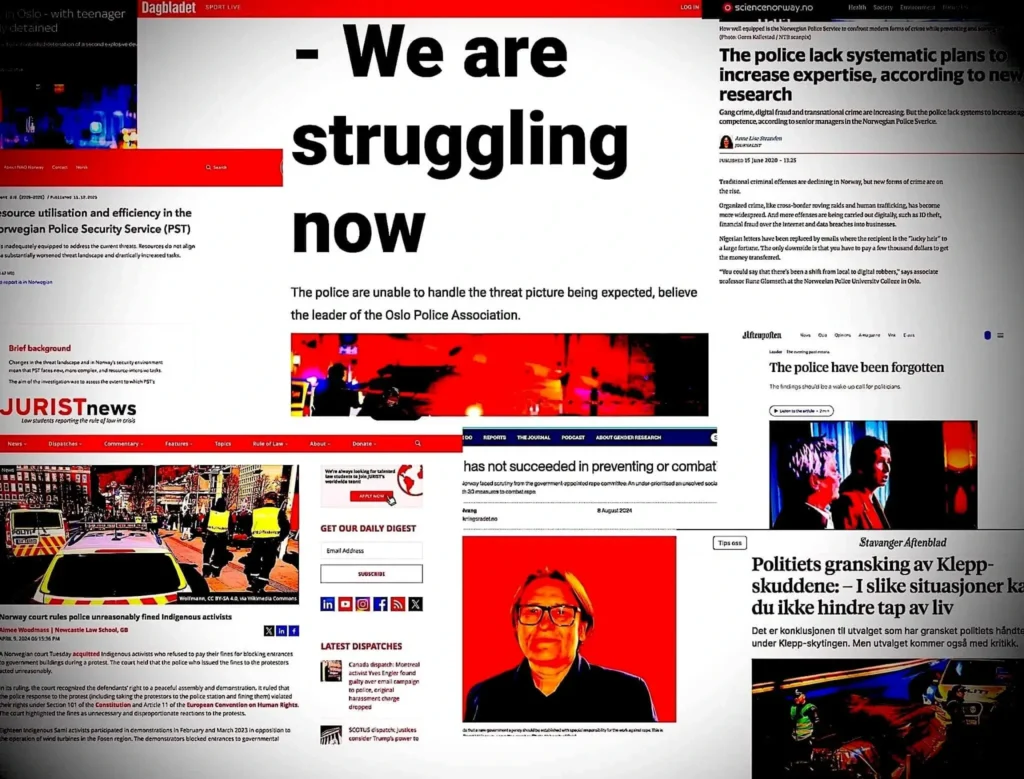
Updated 27.09.2026
An Investigative Analysis of Police Encounters, Institutional Influence, Journalistic Independence, and the Boundaries of State Power in Norway

Gaining Access Through Deception: Vague Verbal Promises and the Manipulation of Trust
The grand legend of deception teaches us that the mightiest fortresses do not fall to the blows of catapults, but collapse when a psychological ruse convinces the defender to unbar the gates from within.
The Trojan Horse was never merely a hollow wooden icon; it served as the inaugural demonstration of psychological deceit and behavioral manipulation where tools of hostility were repurposed as symbols of goodwill, concealing mechanisms of control within a soft shell calculated to disarm innate defenses.
“As the security doctrine of law enforcement expands behind polished facades like the ‘Police Digital Patrol’ (Politiets nettpatrulje) to legitimize institutional penetration under the banners of ‘community outreach’ and offers of ‘supportive assistance,’ a critical imperative emerges to interrogate the boundaries of state control and constitutional protections.”
Crucial Investigative Questions on State Power & Constitutional Boundaries
- Direct Field Intervention:How does this “soft” philosophy transition from interactive screens into direct field intervention via unrecorded phone calls and unsolicited home visits?
- The Tactic of Illusory Assistance:Are these covers deployed to afford genuine protection, or are we witnessing a “tactic of illusory assistance”designed to numb the journalist’s security awareness by creating the illusion that the police are on his side and ready to assist him with everything thereby prompting him to open his private sphere and voluntarily disclose investigative details while law enforcement keeps this “assistance” confined to vague verbal promises to evade any binding legal or procedural commitment?
- The Administrative & Digital Trojan Horse:Or, in the final analysis, are we confronting an “administrative and digital Trojan Horse” engineered to map confidential media networks, dismantle the intelligence architecture of sensitive investigations, and neutralize independent journalism before it reaches public platforms?
Entrapment and the Tactics of Covert Intelligence Gathering
Case studies examining the institutional behavior of law enforcement toward investigative journalists reveal a distinct pattern initiated through “informal, friendly overtures.”
In mid January 2026, this operational model surfaced through direct contact initiated by a police officer and a colleague, who had been dispatched from Bergen to meet with an independent investigative journalist under the stated pretext of offering support and assistance. The approach came against the backdrop of a series of proceedings and legal actions previously pursued against the journalist by the Oslo Police.
“Those efforts included repeated attempts to restrict his publication activities through criminal proceedings advanced through parties linked to criminal networks, as documented by the relevant records, evidence, and published materials. Following successive legal challenges, those proceedings ultimately resulted in the collapse of more than 27 criminal cases, including matters that reached the courts and ended in the debunking of allegations and dismissal of cases.”
Against this backdrop, the officer sought to move the encounter beyond the setting of formal institutional contact and into the journalist’s private sphere by requesting a meeting at his residence. The journalist refused and insisted that the meeting take place at the local police station in his city of residence.
The Operational Architecture: Four Covert Tactics
- Circumvention of Written Protocols:A systematic preference for oral interactions and direct meetings over formal written communications to avoid an administrative paper trail accountable under the law, alongside a total refusal to use text messaging to evade the documentation of stances.
- Environmental and Institutional Reconnaissance:This pattern begins with attempts to inspect the journalist’s physical and private environment via requests for a “home visit” to observe his workspace. When the meeting is forcefully redirected to official police premises, the posture shifts from support offers or formal promises into targeted questioning designed to map source networks, probe funding structures, audit personal routines, movements, common associations, who he meets with, and what he wants, ultimately culminating in exploring the nature of his life.
- Medicalized Coercion and Psychological Stigmatization:When the “soft” engagement approach failed, and the journalist refused their demand to cease publication and writing, institutional intent surfaced clearly on 14 January 2026. Audio recordings documented Lieutenant Petter Hagen issuing an explicit threat to violate the journalist’s personal life space and contact his family physician and other vital institutions to brand him as “paranoid.”This behavior resurrects the darkest totalitarian practices in contemporary history, most notably “Punitive Psychiatry,” which was weaponized by the Soviet security apparatus to label journalists and intellectuals with “delusional paranoia” as a pretext to strip their legal competency a practice formally condemned by international law and the World Psychiatric Association (WPA) in the 1977 Honolulu Declaration. Threatening to enlist the GP (General Practitioner)“family doctor” represents a resurgence of these methods to terrorize the press, execute character assassination, and convert healthcare into a soft guillotine to strip the free voice of its mental and constitutional legitimacy.
- Cross-Departmental Coordination, Jurisdictional Overlap, and Entanglements:Documented facts reveal an operational trajectory extending far beyond the scope of the alleged assistance they promised. According to documentation extending through 7 May 2026, and following the police unit’s cessation of verbal pressures upon the journalist’s steadfast adherence to his professional stance and principles, Lieutenant Petter persisted with his initiatives via a direct telephone call.This communication exposed backchannel contacts conducted by the officer with multiple entities, including the Fredrikstad Police District and the municipal deputy member under investigation who is implicated in documented illegal acts, most recently cybercrimes committed after his unanimous expulsion from the municipal council, as per his documented and published confessions proposing technical modifications to the published material. The officer’s tone, resembling a legal proxy for these entities, his pursuit of the interests of an individual with a documented criminal past, and his ultimate accusation that the journalist lacked credibility upon refusing to make any edits, highlight a clear overlap between the administrative jurisdiction of security agencies and the private interests of subjects under journalistic scrutiny, weaponizing technical communication to directly influence the content of the investigative piece.
Exposure of the Coercive Role: Procedural Immunity, Protective Leverage, and the Suppression of Journalism
The ethical and legal crisis reaches its zenith when service-oriented covers fall away to reveal the explicit deployment of law enforcement powers to besiege journalistic work rather than prosecute documented offenses.
On 21 June 2026, the Municipal Council of Fredrikstad (Fredrikstad bystyre) issued a unanimous resolution ordering the immediate expulsion of a deputy council member following institutional misconduct, specifically exploiting his municipal capacity to circumvent binding judicial rulings in order to suppress investigative reporting and censor free expression. Following his removal, the expelled member engaged in actions classified as cybercrimes, including breaching the journalist’s secure government digital correspondence (Digipost), intercepting communications with municipal and ministerial bodies, infiltrating personal accounts, and monitoring family members.
Rather than fulfilling their constitutional obligation to prosecute the offender and investigate these documented violations, police authorities exhibited severe institutional derailment by engineering “preemptive immunity” and gutting legal remedies. Fredrikstad Police operating with direct legal cover from police prosecutor Linda Tengesdal of the Eastern Police District (Øst politidistrikt), who legitimized these violations on 2 July 2026 under the pretext that his criminal actions “were born out of frustration” moved immediately to close criminal complaints and suppress evidentiary records. Simultaneously, they granted the expelled deputy member unrestricted, direct access to the case files from day one. This act explicitly violated procedural confidentiality protocols, affording an individual documented for fraud and forgery an intelligence advantage to align his actions and escalate his violations under a legal and security umbrella designed to protect him and encourage further offenses.
Field Ultimatum and Operational Overlap
On 7 July 2026, Lieutenant Petter abandoned his “benevolent officer” persona to act as an executive proxy safeguarding cybercriminal activity. Field testimony documented the officer presenting the editorial desk with an explicit zero-sum ultimatum: either cease all publication and investigative reporting, or face passive state abandonment through the formal dismissal of the case, the revocation of police protection, and leaving the journalist and his family exposed to direct cyber and physical threats.
This institutional patronage extended beyond disabling law enforcement; officers actively sought to reinstate the expelled member to the municipal council, accompanied by an explicit demand instructing the journalist to cease all communication with municipal authorities thereby insulating the perpetrator’s interests and concealing facts from the public sphere.
Simultaneously, the officer executed a tactic of “geographical deception” by misleading the journalist into believing the perpetrator was residing in London while claiming to act as a neutral mediator. However, the officer explicitly conceded his intention to convey the outcome of the discussions and the editorial position directly to the offending party. This dual posture reveals a functional alignment and an organic overlap of interests, merging the objectives of a criminal actor with police directives within a unified operational path.
This conduct marks the complete transformation of the police apparatus from a neutral administrative authority and law enforcement body into an instrument of passive coercion. By converting state powers to serve parochial and illicit interests, law enforcement systematically paralyzed legal mechanisms to force investigative journalism into submission and silence.
Institutional Shielding: Oversight as a Mechanism of Impunity
The systemic loop of impunity closes entirely when independent oversight bodies in Norway formally sanitize coercive practices.
Validating the core findings of critical investigations into Norway’s oversight architecture as documented in dedicated institutional analyses the Norwegian Bureau for the Investigation of Police Affairs (Spesialenheten for politisaker) refused outright to initiate an investigation into the matter.
The Bureau rationalized its refusal by adopting the officer’s proposed “informal settlement” between the perpetrator of cybercrimes and the affected party as a sufficient pretext to bypass judicial inquiry.
Operating under the illusion of impartial oversight, the Norwegian Bureau for the Investigation of Police Affairs (Spesialenheten for politisaker) justified its refusal to open an investigation into the matter by adopting the “settlement” proposed by the officer between the cybercrime perpetrator and the affected party as a sufficient pretext to bypass judicial inquiry, thus transforming into a silent mechanism of coercive pressure, amid what appeared to be an intersection of interests between certain law-enforcement officials and individuals whose interests and associations had become the subject of journalistic scrutiny, using that forced reconciliation as a subtle cover to compel the journalist into trading truth for safety while effectively shielding the interests of those connected to the matter from meaningful scrutiny or accountability.
This outcome starkly demonstrates that the oversight apparatus functions as a mechanism for institutional reputation management and police protection, rather than an instrument to hold state power accountable or safeguard affected parties.
Comparative Failure & The Subversion of Public Authority
This procedural threshold places the Norwegian criminal investigation system in stark contrast with regional and international standards of institutional responsiveness. While law enforcement authorities across the globe addressed these documented criminal complaints with strict institutional accountability-where cybercrime and security investigation agencies in other nations initiated the collection of official data and relevant information regarding the perpetrator to pursue the breach, ranging from authorities in the United Kingdom (London) taking complaints with utmost seriousness through documented written and telephonic communications, to the Iraqi National Security Service, and the FBI’s Internet Crime Complaint Center (IC3)-the Fredrikstad Police District in the Østfold region recorded an unprecedented ideological and procedural deviation: converting the apparatus of public authority from an instrument of law enforcement into a protective shield and cover for the offender.
The boundaries of this institutional failure did not stop at disabling mechanisms of justice; they extended to bringing in a police officer from another jurisdiction to act as a “mediator and supporter” to secure the perpetrator’s impunity. This absurd theater culminated in actively campaigning to reinstate the offender to his municipal council seat following an official resolution for his expulsion passed unanimously by the council.
As a journalist who has examined files of corruption and institutional abuse across various regions and countries worldwide-including those facing the greatest challenges in combating corruption-I have never witnessed a procedural decline that disregards basic security norms so blatantly, dispensing even with the foundational legal formalities that the most complex systems strictly preserve. What the authorities practiced here represents an explicit reverse engineering of the function of the state: using legal authority to shield documented crime, and subverting constitutional principles to transform the police force from a guardian of public order into an agent for securing the perpetrator, supporting crime, and suppressing the truth.
When the system designed to protect society transforms into a tool for its silent subjugation, we evoke great maxims that map the contours of this deviation. Let us take Socrates’ warning against corridors that fear the light far more than chaos, and ponder Voltaire’s insight as he reminds us that “to know who rules you, simply look at who you are not allowed to criticize,” culminating in Nietzsche’s diagnosis that monsters may colonize the very structures erected to keep the abyss at bay when compromised security uniforms and complicit oversight boards descend to become administrative custodians of factional corruption, weaponizing extortion to silence the truth.
To deal in absolute truths requires clear distinction; painting these violations across state institutions at large represents a flawed reading, as security units remain that perform their duties with high professionalism and the logic of the law. Yet the structural danger lies precisely within that specific clique: the compromised prosecutor, cross-departmental networks of interest, and functional cronyism forming pressure blocs that operate in defiance of the law, deliberately subverting court rulings running counter to their agendas to paralyze the administrative process and provide a protective umbrella for parties with criminal records.
When oversight and police institutions fall into the trap of self-image preservation and abandon their mandate to conceal unwelcome truths, defending the law transforms from an institutional obligation into an imperative for independent journalism. The Trojan Horse relies on the defender’s slumber, and once the mask falls, deception loses its power; regardless of how numerous bureaucratic cover up deals may be, the truth remains the ultimate ceiling, and the badge stays an instrument of legality rather than a franchise in the hands of those who tamper with the law.
Source
https://www.nrk.no/vestland/xl/nar-politiet-er-pa-facebook-1.13070750
https://www.met.police.uk/ro/report/ocr/af/how-to-report-a-crime
https://filessos.com/httpsfilessoscomthe-flight-of-the-expelled-candidate-out-of-the-norway
https://filessos.com/fredrikstad-municipal-council-files