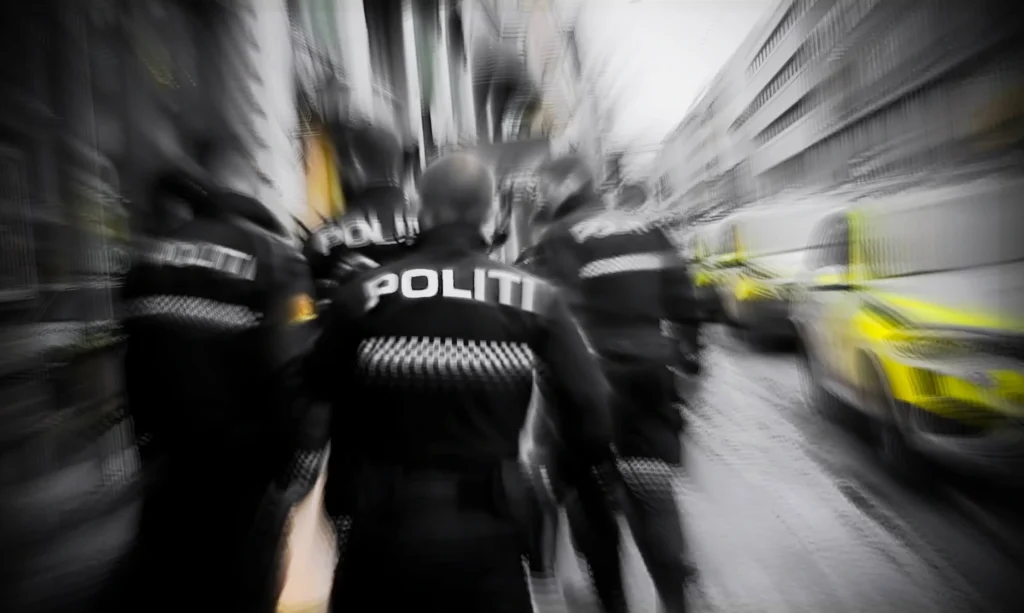

Fear as Policy: How the Oslo Police Confront Criticism
In the official self image of the Oslo Police, fear of criticism does not appear as a temporary sensitivity or a passing media concern. Rather, it functions as an institutional condition that shapes behavior whenever scrutiny approaches structural failures or sensitive internal files. This is not merely anxiety over public embarrassment, but a documented pattern of resistance to independent narratives when criticism threatens areas the Oslo Police treat as shielded from accountability.
A report issued by Norway’s official Police Evaluation Committee, following a series of internal scandals, explicitly highlighted weak oversight mechanisms and a recurring reluctance within police leadership to address errors transparently particularly when criticism originates outside the police institution, from independent journalists or researchers not embedded within official structures. This reluctance was not procedural, but institutional, reflecting concern over losing control of public framing rather than correcting misconduct.
This pattern became particularly visible in 2021, when a limited circulation academic report titled “Corruption and Unethical Conduct in the Nordic Police Forces” was released. The report drew on official Norwegian findings following the Erik Jensen case, one of the most serious corruption scandals in the history of the Oslo Police, and examined structural corruption and oversight failures within Scandinavian law enforcement. Instead of being met with academic rebuttal or open institutional engagement, the report was subsequently removed from the website of the Nordic Research Council for Criminology raising serious questions about how criticism is handled once it reaches the core of police authority.
The removed report has been made available to the public and is placed at the bottom of the page for full access. The report addresses police corruption in Oslo following the “Eirik Jensen” scandal, highlighting leadership failures, weak internal oversight mechanisms, and prolonged neglect of violations. It also examines the influence of institutional culture on police ethics, emphasizing the urgent need to strengthen accountability and oversight to ensure transparency in handling misconduct and to protect institutions from systemic corruption.
From Institutional Sensitivity to Operational Suppression
The Oslo Police’s sensitivity to criticism does not stop at academic research or journalistic analysis; it extends into far more dangerous territory when it reaches direct pressure on journalists. Independent accounts and publicly documented incidents describe sudden police visits to the homes of journalists or publishers shortly after the release of controversial investigations. These actions, carried out without any clear judicial mandate, resemble displays of power rather than lawful enforcement signals of deterrence rather than accountability, boundaries on exposure rather than transparency.
Even more concerning, public resources have at times been used not to enforce the law, but to control media narratives, suppress testimony, and target whistleblowers and victims as reputational risks to the institution. In such instances, policing shifts from protecting rights to managing exposure, and from safeguarding justice to preserving institutional image.
Targeting the Messenger: Legal Retaliation and the Policing of Truth
Within this context, a documented case emerged in which a journalist was subjected to sustained pressure through strategic, retaliatory legal actions designed to deter further publication. This pressure followed the journalist’s exposure of a scandal revealing severe vulnerabilities in the interaction between Oslo’s health oversight bodies and employees of the County Governor in Oslo. The investigation uncovered unlawful cooperation between these employees and a physician involved in documented legal violations, with these same officials seemingly enjoying apparent immunity from accountability. These authorities enlisted officers from the Oslo Police to suppress disclosure and contain the documented scandal, transforming the legal apparatus into a tool serving personal interests, relationships, and loyalties cases against the physician were closed, while charges were brought against the citizen, tipping the scales in favor of the institution over the law. The objective was not institutional correction, but forcing the journalist to remove reporting that exposed a structure built on controlling public narratives and projecting a misleading image, instead of transparency or lawful oversight.
Taken together, these incidents reveal that this is not a series of isolated mistakes, but a deeply entrenched institutional posture: the police regard criticism not as a corrective mechanism, but as a threat to be contained. When a law enforcement authority fears scrutiny more than it fears misconduct, the issue ceases to be mere public relations and becomes a fundamental legitimacy crisis, where public trust is endangered, and the law becomes a façade for consolidating power.

In the eyes of the Oslo Police, the press is not a mirror for reflection, but something to be broken or neutralized; when the light is feared more than misconduct, justice becomes a game of influence, truth a luxury too costly to bear, and corrosion begins silently from within yet at a public cost that strikes at the very core of trust in an institution meant to guard the law, not its own narrative.

This research was removed from the Nordic Research Council for Criminology website and was previously available here. It is now republished on alternative platforms such as Filessos.com after the official source was blocked.
The study examines corruption and unethical conduct within Nordic police forces.
Additionally, Oslo Police removed links to a Norwegian government reports that informed a contact seminar on 21–22 October 2021. The report, Police corruption. Leadership, risk recognition and lesson learning (Politikorrupsjon. Ledelse, risikoforståelse og læring av erfaringer), addresses police corruption, leadership, risk recognition, and lesson learning, and was previously accessible here.
In a courageous move, the The Nordic Research Council for Criminology decided to republish the report Corruption and Unethical Conduct in the Nordic Police Forces as a separate file on its official website on October 22, 2025, noting that its content is based on a seminar held on October 21–22, 2021.
Prior to this, the report had been republished on independent platforms such as forbiddenfileshub.com and filessos.com to ensure it remained accessible to the public after it was removed and access to the information was restricted.
However, some links and references within the report remain unavailable or restricted, due to restrictions imposed by the Oslo Police to limit public access to the information.
Sources:
https://helserett.com/en/oslo-healthcare-oversight-failure
https://www.reddit.com/r/oslo/comments/ylt0g2/so_a_swat_team_showed_up_at_my_door/