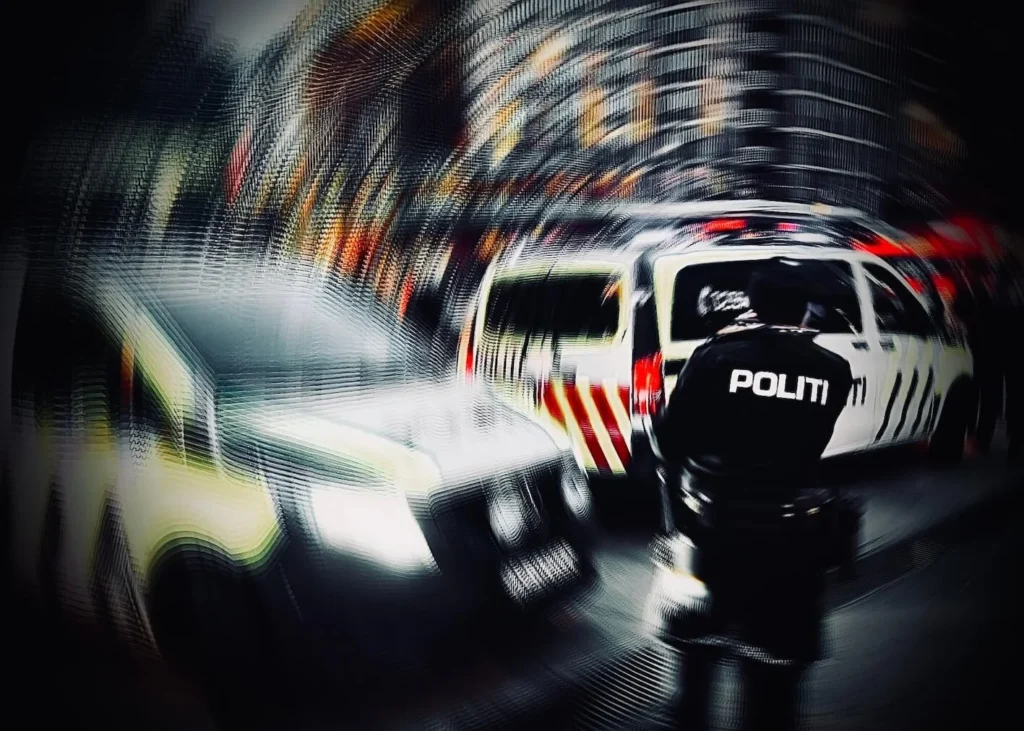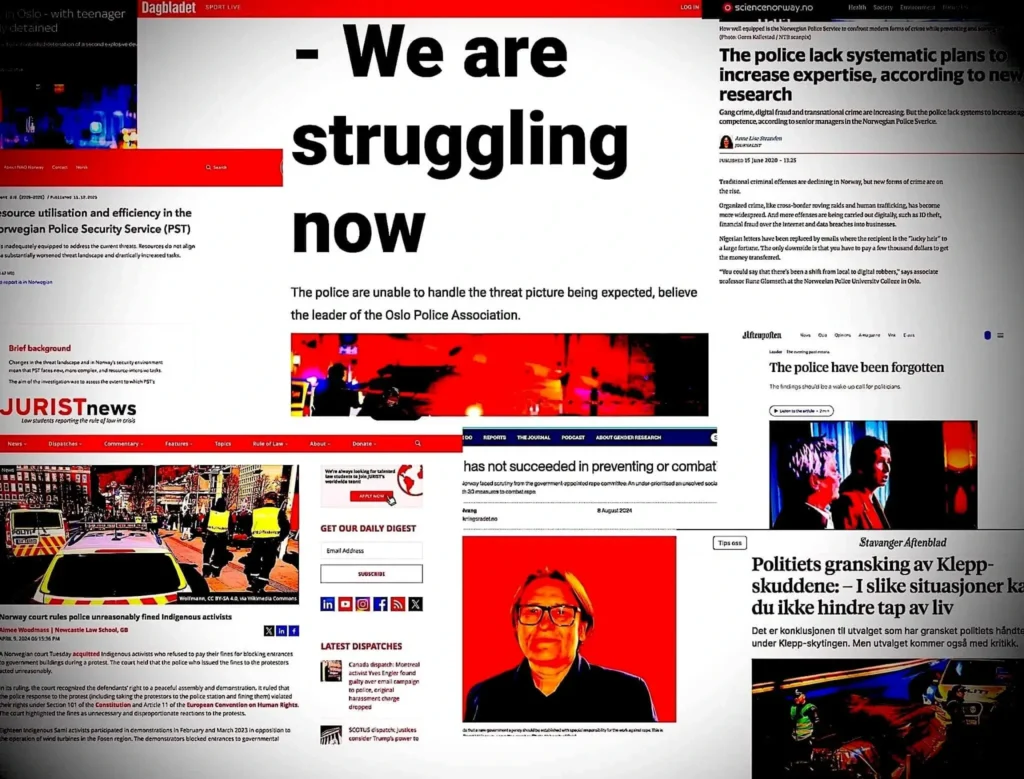

What has been revealed inside the Norwegian police in recent years is not a series of isolated incidents, but a coherent pattern.
Research led by Dag Ellingsen and Ulla Britt Lilleaas between 2020 and 2022 described a closed institutional environment in which authority is internally reproduced: degrading language, male dominated hierarchies, and a silence that protects behavior rather than exposing it.
These findings did not close the case.
Subsequent oversight reports including those of (Spesialenheten for politisaker) the Norwegian Bureau for the Investigation of Police Affairs through 2024 suggest that the problem did not disappear; it evolved, shifting from internal culture to practices that engage the limits of authority itself.
At this point, the question changes.
It is no longer confined to what happens within the institution, but to what happens when this culture moves into direct contact with individuals when authority ceases to be merely procedural and becomes proximity.
At that proximity, violation is not always explicit.
But it becomes possible.
This is not an abstract shift. It takes form in practice most visibly within the Oslo Police.
And it is precisely from this space, between authority and the body, that this report begins.
The problems of the Oslo Police in Norway are no longer confined to administrative failures or instances of corruption they point to a deeper structural fault.
From misconduct within the institution itself including improper handling of sensitive materials to cases that raise serious concerns about professional boundaries and the treatment of vulnerable individuals, the pattern is difficult to ignore.
This report goes to the most sensitive point where these failures converge:
when authority moves too close to the body… and begins to redefine its boundaries.
When the distance between officer and citizen narrows beyond its limits, it ceases to be procedural it becomes a legal risk long before it is recognized as misconduct.
In that narrowing, a silent space emerges one in which power, vulnerability, and consent collide.
What remains unstated in formal language is often where the harm resides:
the moment when a uniform is no longer protection but leverage.
Official reports do not accuse the Oslo Police of a single, unified pattern of sexual exploitation. What they reveal is more unsettling:
an institutional environment where authority can slide toward the body without sufficient restraint.
In the 2024 annual report issued by
Spesialenheten for politisaker
Oslo appears across multiple cases that cannot be read in isolation:
- Covert recording within a police workplace, with the camera directed toward intimate areas of individuals’ bodies
- Improper storage of sensitive police documents
- The presence of material related to child sexual abuse on digital devices within a professional context
In one case referenced in the same report, digital evidence revealed a convergence that should not exist inside a law enforcement environment:
unauthorized recordings, unsecured police data, and sexually explicit material intersecting within the same institutional space.
These are not conventional sexual crimes committed on the street. They are more severe:
a breach of boundaries within the institution itself where oversight is presumed to be strongest.
In another case, strip searches were conducted in an Oslo detention facility under camera surveillance without adequate visual masking.
The authority deemed this a violation of guidelines, yet not sufficient to meet the threshold for criminal conviction
(Spesialenheten for politisaker, Annual Report 2024, “custody and coercive measures”).
This concern is not confined to internal oversight. International monitoring bodies have also raised questions about the use, proportionality, and safeguards surrounding strip searches in Norway (Association for the Prevention of Torture, Global Report on Norway).
The implication is stark: a person can be fully exposed under state control, recorded in a vulnerable condition, and still fall short of the legal definition of criminal harm.
Here, the gap becomes visible:
what is framed legally as a “procedural breach” may, in practice, amount to
a full violation of bodily integrity.
In legal language: absence of crime.
In lived reality: presence of violation.
Authority as Access Not Protection
Sexual misconduct cases within the Norwegian police, as documented in official reports, follow a recognizable pattern:
- A police officer
- A woman in a vulnerable position
- An interaction initiated through an official role
- A relationship that ends in personal gain
This pattern is not hypothetical. Officers have been convicted in such cases,
with courts emphasizing that the officer’s position itself undermines the possibility of free consent
(as reflected in reports by Spesialenheten for politisaker).
In one case documented in official reports by the Norwegian Bureau for the Investigation of Police Affairs (Spesialenheten for politisaker), an officer established contact with a woman through his professional role in a drug related environment.
The court found that he obtained sexual activity by exploiting her vulnerable situation, emphasizing that the power imbalance inherent in his position undermined the possibility of free consent.
In other documented cases, contact originated during police duties:
after a report was filed, during follow up questioning, or in the aftermath of a request for assistance.
The line between professional access and personal exploitation did not collapse suddenly it shifted, gradually, under the cover of authority.
Yet these cases are often treated as exceptions.
What the Oslo related findings suggest is something deeper:
a structural susceptibility to boundary violations.
When an officer holds:
- The power to detain
- The power to investigate
- The power to define legal status
any contact outside professional boundaries ceases to be neutral.
It becomes an unspoken extension of authority.
And within that extension, exploitation can occur without ever naming itself as such.
Numbers That Conceal More Than They Reveal
Official data exposes a stark imbalance:
- Hundreds of complaints against police annually
- Only a small fraction result in prosecution or sanctions
- The majority are closed before reaching full investigation
(Spesialenheten for politisaker, Annual Report 2024)
This disparity is not incidental. It reflects how complaints are processed at a structural level. According to the official case handling procedures of the Spesialenheten for politisaker, cases are assessed at an early stage and may be closed if there are insufficient grounds to proceed with a full investigation.
In many cases, complaints are dismissed early often in contexts where evidence depends on the word of a vulnerable individual against that of an officer.
The closure rate is not a footnote. It is a defining feature of how the system operates.
(According to the 2024 report by Spesialenheten for politisaker).
The superficial reading: the police are largely compliant.
The deeper reading:
the system designed to uncover truth may be structured to close it prematurely.
In cases of sexual exploitation
where evidence is scarce, documentation limited, and power asymmetrical
justice shifts from a process of inquiry to an almost unattainable standard of proof.
Oslo Specifically: When Documentation Fails, Accountability Fails
In multiple cases, the investigative authority notes that insufficient documentation hindered the ability to verify the legality of police actions
(2024 report, “documentation deficiencies”).
In at least one Oslo related case, the absence of proper reporting meant that investigators could not reconstruct the sequence of events leading to a contested police action.
Without records, there is no timeline. Without a timeline, there is no accountability.
Put plainly:
when an officer fails to document their actions, the misconduct does not merely disappear
the possibility of holding them accountable disappears with it.
Documentation, then, is no longer administrative.
It is the last line of defense for the body.
And when that line collapses,
what disappears is not a file
but a right.
From Individual Misconduct to Institutional Susceptibility
The Oslo Police cannot, in legal terms, be described as a coordinated system of sexual exploitation.
But they can and should be questioned for something more critical:
- An environment that allows uncontrolled proximity to the body
- Oversight that is reactive rather than preventive
- Structural gaps in documentation
- Outcomes that rarely align with the volume of complaints
What emerges is not a conspiracy but a condition:
a system in which the misuse of authority does not require coordination, only opportunity.
This is not a single scandal.
It is a system capable of producing scandals without exposing them.
The Question Yet to Be Asked
How many cases go unreported?
How many interactions begin as “assistance” and end as implicit coercion?
How many women are unable to distinguish between legal authority and personal pressure?
How many interactions leave no trace precisely because they were never meant to?
And how many files were closed simply because they were never properly written?
In Oslo, the issue does not erupt in one explosive scandal.
It erodes in silence.
And that silence within an institution empowered to approach, search, and detain the body
is not neutral.
It is, by all available indicators,
a space where violation remains possible.
Conclusion: When Trust Becomes an Administrative Claim
Trust in policing is not measured by institutional statements.
It is measured by what happens when scrutiny disappears.
In Oslo, the documents do not claim that abuse is the rule.
But they reveal something more troubling:
It is possible enough to concern.
It is recurring enough to document.
It is difficult to prove enough to persist.
And persistence, in this context, is not neutrality it is failure.
And this is where real institutional failure begins:
not when the police commit misconduct,
but when misconduct becomes structurally survivable within the system itself.
When the body becomes a space of power, the badge turns into a mark of shame.