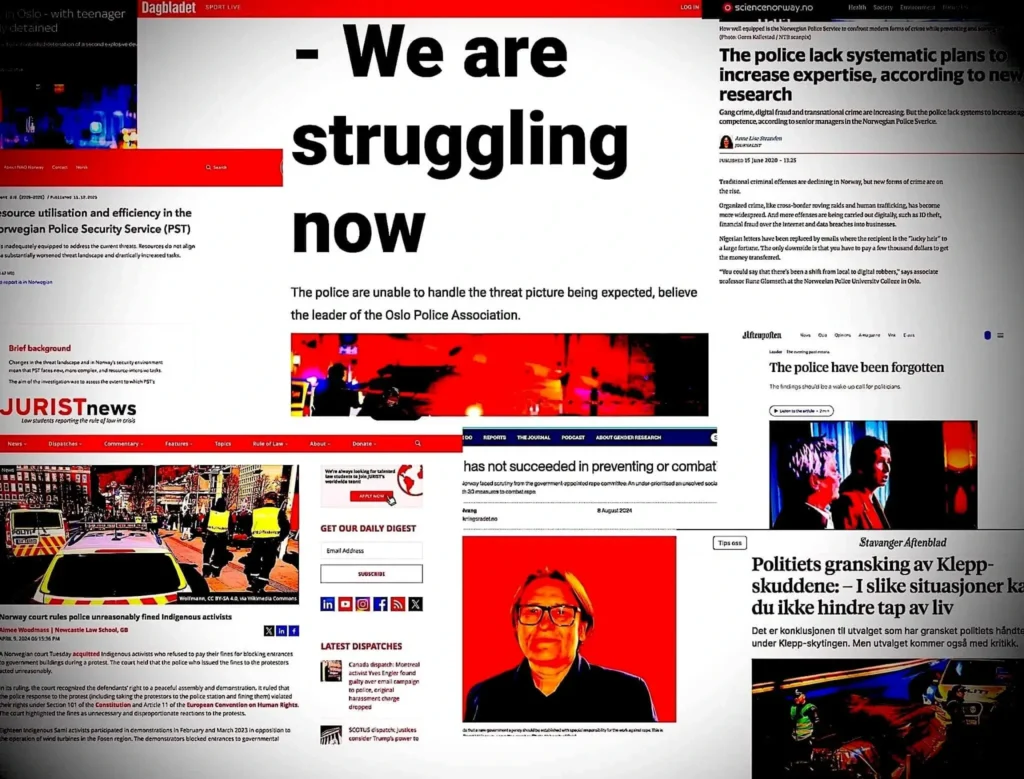

In the city that awards the world the Nobel Peace Prize, and behind the gleaming glass facades of its security institutions in Oslo, a stark paradox unfolds. While the image of a model state is exported abroad, a different reality grows quietly within: a disciplined bureaucratic absurdity that slowly consumes the essence of justice.
Here, cases do not always die in courtrooms; many are buried before they ever reach them. Crime becomes a number, the victim becomes a file placed on the shelf (Henlagt), and justice turns into a selective privilege rather than a universal right granted to those who can endure years of waiting, or withheld from those whose names, appearance, or skin color place them under permanent suspicion.
“Institutional” Corruption: Beyond the Shadow of “Eirik Jensen”
When Eirik Jensen fell, it was not merely a corrupt officer who collapsed, but the myth of absolute integrity with him. Legal philosophy reminds us that corruption does not emerge in a vacuum. How does an officer spend decades guarding a major drug network under the watch of his own command structure?
Corruption within the Oslo Police is not limited to petty street level bribery. It is structural, rooted in a “culture of silence” (bureaucratic Omertà). A two year investigation into an officer over leaked crime scene images or bribery, only to end with the case being shelved, is not simply procedural delay. It is a strategy of cooling down.
Here, law functions less as a tool of accountability and more as a shock absorber. The institution protects the “uniform,” because publicly sacrificing a corrupt individual would imply a deeper admission of systemic administrative decay.
The “Sociology of the Shelf”: Deferred Justice is Denied Justice
In Oslo, approximately 75% of reports filed by ordinary citizens end up shelved. Philosophically speaking, this signifies that the state is actively relinquishing its legal sovereignty in favor of a codified state of chaos. When police lawyers are internally instructed to conceal the justification of “lack of capacity” (Kapasitetsmangel) and replace it with ambiguous terminology, we are no longer dealing with an administrative failure we are witnessing a calculated manipulation of public consciousness.
- Class Based Justice: If a citizen’s bicycle is stolen in Grønland, the file is closed within seconds under the guise of an “unknown perpetrator.” Yet, if an officer breaches sensitive data, he is investigated for years to effectively dissolve the truth.
- The Dictatorship of Efficiency: The police have internally decreed that investigating financial fraud below 100,000 NOK is simply unprofitable. In doing so, the police force transitions from being the guardian of rights to an accountant’s office, where human dignity is measured by the cost-effectiveness of a balance sheet.
Racial Profiling: The Conditional “Social Contract”
The practices of the Oslo police, particularly in the East End, represent a violent tearing of the social contract. To subject a young man to a random stop and search based strictly on his physical appearance (Ethnic Profiling) is a blatant declaration that citizenship in Norway carries distinct “tiers.”
The very police force that seamlessly shelves rape and domestic violence files under the pretext of “insufficient evidence” suddenly finds a surplus of time to hunt down immigrants in the streets just to verify their identities. This profound contradiction embodies a severe legal schizophrenia: the authority remains mercilessly draconian toward the vulnerable, yet remarkably empathetic and suspiciously patient toward its internal corruption.
The “Independent Bureau”: Prosecutor and Judge Wrapped in Horrifying Statistics
There is no legal farce heavier than an investigative body populated by officers evaluating their former colleagues. The absolute impunity granted to an officer who stored graphic photos of deceased victims on his personal phone, excused by the claim that “the Oslo police lacked clear regulatory guidelines prohibiting this,” stands as the absolute zenith of institutional mockery.
The official data published by the Norwegian Bureau for the Investigation of Police Affairs (Spesialenheten) exposes a silent legal massacre:
- 95% to 97% of all complaints and reports lodged against police officers are coldly dismissed and shelved without a single criminal sanction.
- More alarmingly, 64% to 65% of these cases are cast aside immediately, without the bureau even bothering to initiate a preliminary investigation, buried under the standard claim of “no indication of a criminal offense.”
- The rare cases that manage to escape instant execution and linger for months or up to two years are ultimately led to a legal slaughterhouse known as “shelved due to the state of evidence” (Henlagt på bevisets stilling).
This structural defect is no longer a hidden secret. Professor Mads Andenæs, a prominent professor of law at the University of Oslo, publicly stated to the Norwegian media that these extraordinarily high dismissal rates severely compromise the integrity of the entire judicial system. Meanwhile, in the digital sphere, the Norwegian Reddit community (r/norge) boils with anger, as citizens share frustrating accounts of presenting concrete evidence against police misconduct, only to wait years before being slapped with a dismissal based on “lack of capacity” (Kapasitetsbegrunnelse). This has fueled escalating public demands to completely purge former military and police personnel from the bureau, replacing it with a strictly civilian, independent oversight body.
Dissecting a Living Case: The Two Year Enigma and the Death of Legal Certainty
Let us strip away the theoretical veneer and examine the raw, open wound of the Oslo police through a surreal, real-world case: the officer who remained under the guillotine of investigation for two consecutive years.
In the political philosophy of Giorgio Agamben, there exists a concept known as the “State of Exception,” wherein the sovereign suspends the law under the pretext of protecting security. What occurred behind the scenes of this case is a vivid manifestation of this theory: two full years of calculated bureaucratic stalling.
- The Timeline of the Investigation and Administrative Suspension: The saga began with a severe report accusing the officer of corruption and gross abuse of authority (transferring and storing highly confidential images from active crime scenes onto his personal device). Immediately, the officer was removed from public sight and quietly reassigned to a “desk job” to shield the department from media scrutiny. For two long years, the Independent Bureau engaged in extended bureaucratic rituals examining phones, summoning witnesses, and reviewing internal files. The objective was never to unearth the underlying truth; it was a chronological engineering tactic betting heavily on the short memory of the public.
- The Shocking Dismissal and Absolution: As soon as the two years concluded, once the public fervor had cooled and media collective amnesia was complete, a joint decision was quietly handed down by the investigative bureau and the prosecutor: the case was shelved due to insufficient evidence.
- The Surreal Legal Outcome: The officer was not dismissed from his job as a punishment; rather, he was dismissed from the case and fully exonerated. By virtue of this archiving, the entire matter was wiped from his criminal record as though it never transpired. The very next day, he returned to his active duties within the Oslo police force, fully armed with his badge, his gun, and his absolute authority over the citizens. Only in exceptionally rare instances does the Director General of Public Prosecutions (Riksadvokaten) intervene to reopen these judicial graves, and only when the stench of collusion becomes too pungent to conceal.
Here we arrive at the ultimate paradox: the very apparatus that prosecutes ordinary citizens for their ignorance of the law completely exempts itself from accountability by pleading ignorance of its own regulations. This living case is not a mere display of administrative laziness; it is an existential escape route proving that the law in Oslo protects the architecture of power first, leaving the victims perpetually suspended on the ropes of time.
The Official Graveyard of the Social Contract
“The philosophy of power teaches us that the most insidious form of corruption is not the one that openly violates the law, but the one that hides beneath its robes to protect itself. A police apparatus that finds years of time to dilute the indictments of its own officers, yet cannot spare five minutes to deliver justice to its citizens, is an apparatus suffering not from a ‘lack of resources,’ but from ‘the death of professional conscience.’ When the law mutates from an instrument of establishing righteousness into a cooling strategy designed to shield the uniform, justice in this city becomes nothing more than a polished Scandinavian illusion. It is a brilliant glass veneer concealing a terrifying existential truth: in the utopia of Oslo, everyone is under the law except those who wrote it.”