
Investigative Report on the Gap Between Official Discourse and the Reality of Justice
From Narrative to Conclusive Evidence.
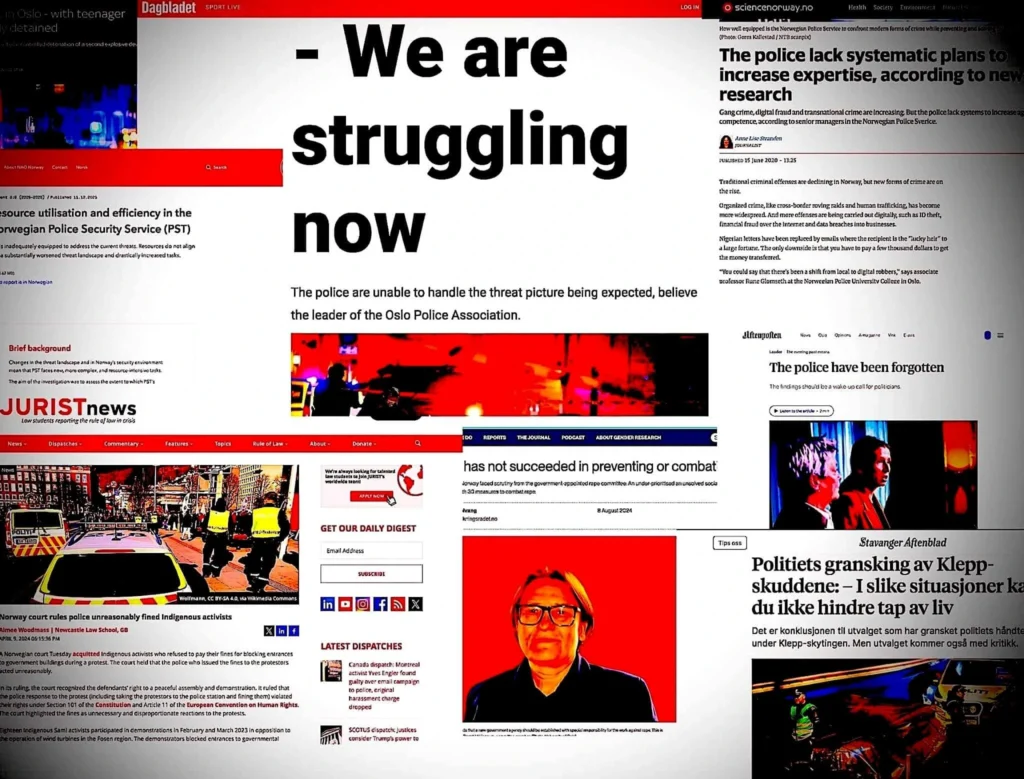
After a series of readings, analyses, and articles reviewing the history of the Oslo Police, and after opening internal files from institutional corruption to operational failures, to chronic shortcomings in human trafficking cases and the lack of personal legal and moral support for its personnel it is no longer possible to rely solely on theoretical analysis or historical critique. What is happening on the ground now presents itself as conclusive evidence that this force has not learned from the past and has produced no real transformation in its structure or behavior.
This article is not an additional episode in a series of critiques or investigative projects, but a decisive point that completely dismantles the claim of “institutional learning” that the police repeatedly promote in their official discourse. Recent developments do not represent an incidental deviation but reveal, with stark clarity, the deep rooted causes behind previous failures: a problematic network of relationships, selective leniency toward those involved in human trafficking, distorted use of legal procedures, and unethical practices against journalists, whistleblowers, and witnesses, where law enforcement is applied according to the personal whims and preferences of Oslo police officers resulting in legal chaos that wastes public resources on paths driven by internal bias and emotion rather than the law.
What follows is not an opinion or constructed conclusion but a documented review of recent facts showing how security failures, procedural deviations, and abuse of power intersect in unprecedented ways, exposing that the problem within the Oslo Police was never limited to a single incident or case, but is a recurring pattern whenever citizens believe the worst has passed in the capital.
This report begins here, not as a new condemnation, but as a practical summary of all that has been revealed where the present no longer just explains the past, but exposes and confirms it.
1. Reassuring Discourse… and a Crumbling Reality
Whenever Oslo Police face a security crisis, the same phrase returns: “The situation is under control, and the police continuously improve their performance.” A consistent, polished phrase produced with political care. But when this discourse is tested against published facts, it does not hold up.
National audit reports, police confessions, investigative journalism, and daily citizen experiences paint a radically different picture: an institution suffering from structural defects, not circumstantial errors. The gap here is not linguistic or media-based but a gap in performance and accountability.
2. Kampen: When Prevention Failed Before Response
In August 2025, Tamina Johar was killed in the Kampen neighborhood. After the crime, the police did not deny responsibility but made a dangerous admission:
Information flow between the police and the Police Security Service (PST) “did not function as it should,” and preventive measures were “linked to individuals, not the system.”
This admission, published in VG, is not a technical detail but a direct indictment of the very philosophy of security work. The killer was known to authorities. The information existed. The result: the crime occurred.
Here, the myth of “smart prevention” collapses. When the police fail to turn knowledge into prevention, knowledge without preventive action becomes an ethical crime in itself.
3. Riksrevisjonen: When the State Condemns Its Own Force
In December 2025, the national auditor issued one of the harshest reports on PST. The report does not discuss minor deficiencies but structural unpreparedness to face threats, resources inadequate for task volume, and administrative failures within the ministry itself.
When the top oversight body cannot gloss over reality, the official narrative loses its legitimacy.
4. A Police Force Without Institutional Memory
Research published in Science Norway reveals that the Norwegian Police lack a systematic framework to develop expertise and do not have an institutional mechanism to learn from mistakes or keep pace with modern crime.
Result: a force that reacts rather than anticipates; responds rather than prevents.
Lack of institutional learning means every crisis is managed as if it were the first, and every failure is reproduced.
5. Citizens Outside the Equation
Local forums, including Reddit, repeatedly reflect the same complaints: delayed response, ignored reports, lack of follow-up. These are not legal judgments, but social indicators of eroding trust.
When citizens lose daily trust, journalistic data cannot compensate.
6. Klepp: Operational Failures in Critical Moments
In the Klepp shooting incident, an independent evaluation found that the police were neither information-ready nor organizationally prepared to handle the case. Yet the police insisted they had not erred.
This contradiction between external assessment and internal defense reveals a culture of denial, not correction.
7. Cases Closed… Not Solved
Closing the investigation of a fight aboard a Norwegian Air flight due to “lack of evidence,” despite an official report, raises a serious question: Is the problem with evidence, or the ability to utilize it?
This closure reveals a deeper crisis: the system possesses information but is incapable of turning it into preventive action or tangible justice.
8. Civil Rights: When the Police Fail in Court
A Norwegian court found that the police acted unreasonably against Sami activists during a peaceful protest. The ruling did not only critique the outcome but the methodology itself, revealing that abuse of power becomes structural rather than exceptional.
This police force in Oslo did not merely fail to uphold the law; it demonstrated that a misreading of authority can become a framework for systematic abuses.
9. The Gap That Cannot Be Measured by Data
This gap cannot be measured by the quality of journalistic data or the skill of media spin, but by its consequences: on justice, on the position of the victim, and on the practical meaning of the rule of law.
In the case of Eirik Jensen in Oslo, the facts after years of regulatory failure and silent complicity led to harsh judicial rulings, reaching the maximum allowed by law. Yet the significance lies not in the severity of the sentence, but in the path that preceded it: prolonged negligence, delay, and failure to detect misconduct early within the institution itself. Justice here was not the fruit of a vigilant system, but the result of a late exposure of a flaw that had long surpassed containment a critical difference in public trust.
In human trafficking cases, international evaluations, particularly by the Group of Experts on Action against Trafficking in Human Beings (GRETA), highlighted structural shortcomings in how the Oslo Police identify and support victims, coordinate investigations, and provide protection. GRETA also urged the Oslo Police to strengthen their mechanisms, clarify procedures, improve officer training, and enhance data collection and internal coordination to ensure that victims are properly detected, supported, and referred to appropriate services.
GRETA repeatedly urges Norway to establish a formal National Referral Mechanism, clarify procedures for victim identification, improve training for enforcement officials, and enhance data collection and inter‑agency coordination to ensure that victims are properly detected, supported, and referred to services.
These gaps in institutional response, rather than isolated operational failures, weaken law enforcement effectiveness and reduce the practical protection available to vulnerable groups.
The graver problem emerges in cases revealed by independent documents and journalistic investigations, which were suppressed for decades by elements within the Oslo police, forcing journalists to leave the capital to safeguard their lives. Here, failure extends beyond the inability to protect victims, encompassing the repurposing of law itself as a tool of coercion and covert extortion.
Legal procedures are inverted: protracted measures exhaust witnesses, discourage disclosure, rely on ethically questionable charges, and investigative tracks end by drying up testimony instead of dismantling criminal networks. This is not a technical performance flaw it is a profound ethical crisis in understanding the function and the law itself: is the police a justice enforcing body, or a crisis management apparatus focused on narrative control, reputation protection, and internal interests?
Here the deepest problem crystallizes: when protecting the institutional image becomes an unspoken priority, the law turns from a tool of rights into a tool of control; transparency becomes a threat; whistleblowers, journalists, and victims are redefined as nuisances and threats to the institution, not partners in justice.
Taken together, these facts do not indicate individual failures or isolated cases, but cumulative institutional dysfunctions within the Oslo police, placing it in key files outside the Scandinavian model it presents to the world. The rule of law is not measured by the eloquence of its rhetoric, but by its ability to withstand criticism, protect the vulnerable, and hold itself accountable before exposure imposes accountability by force.
After this series, claims that the police “learn” or “change” lack any real basis. What repeats is not error, but denial of error; not stumbling, but insistence.
In Oslo, as these files reveal, the test is far from settled… and the indicators so far are unsettling.
The question is no longer whether the Oslo police have erred, but whether they have learned anything at all:
- What did they learn from their catastrophic failure during the July 22, 2011 attacks, which claimed 77 lives due to slow response, poor coordination, and a collapse of leadership at the critical moment? Did the event become an institutional lesson, or merely a memory cited in speeches and forgotten in decision rooms?
- What did they learn from the Eirik Jensen case, where corruption went undiscovered for years, evolving from individual misconduct into a silent network of tolerance and protection? Did the police redefine internal oversight mechanisms, or did they simply scapegoat after the fact?
- In human trafficking cases, the Oslo police reproduced the Jensen level failure institutionally: witnesses became accused, investigations were closed to protect officers with personal ties to traffickers, and cases were silenced while networks continued operating unchecked. Some network members forged direct friendships with police officers, shared housing with them, and leveraged their influence to extort victims the law no longer a tool of justice, but of coercion and protection of corruption.
- What did they learn from judicial criticism, national oversight reports, investigative journalism, and citizen testimony? Was learning ever the goal, or was the real goal containing scandal, controlling the narrative, and safeguarding institutional reputation at any cost?
If all these milestones from July 22, to Jensen, to trafficking networks, to recent failures have produced no clear structural change, the more honest question becomes:
Are the Oslo police incapable of learning? Or do they simply see failure not as a reason for change, but as a danger to be hidden?
Sources:
https://www.reddit.com/r/Norway/comments/16a5bo3/so_let_me_get_this_straight_police_will_come_to/
https://www.aftenbladet.no/lokalt/i/7ply0B/politiet-mener-ikke-de-gjorde-feil-under-klepp-skytingen
https://www.aftenbladet.no/lokalt/i/JOE9P6/slaasskamp-paa-norwegian-fly-saken-henlagt-av-politiet
https://filessos.com/oslo-files
https://rm.coe.int/greta-third-evalution-report-on-norway/1680a6ce66?utm_source=chatgpt.com