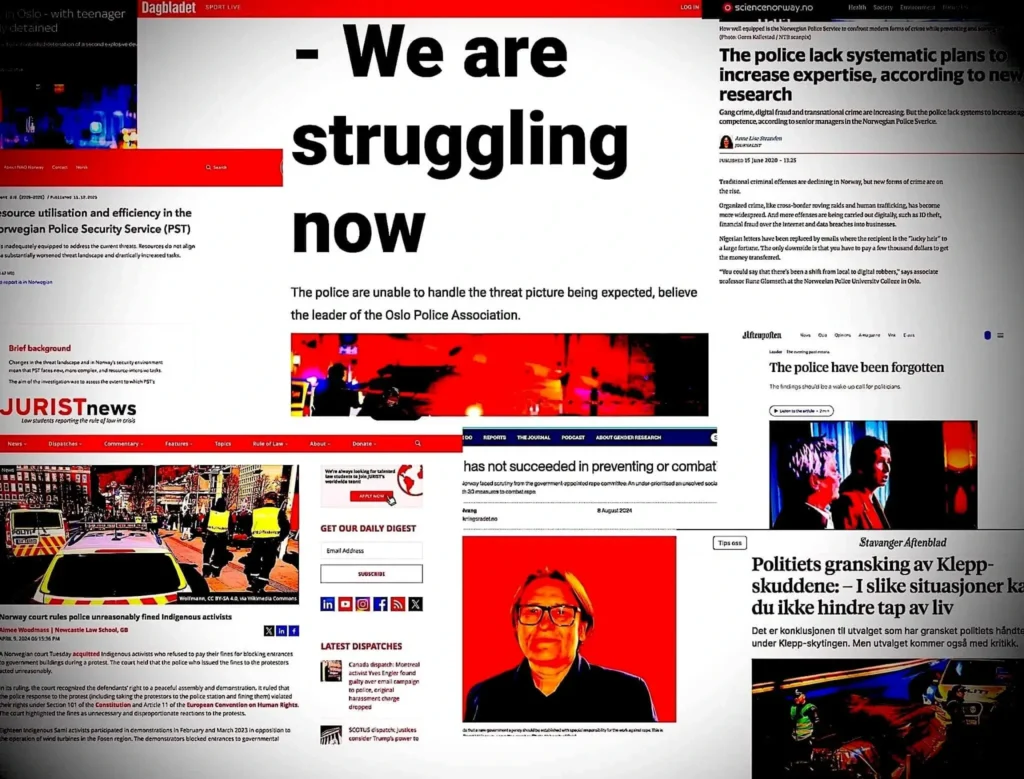

When Authority Is Tested at Its Blind Spots
This is not merely a narrative of a scandal.
It is an attempt to dismantle a structure that allows scandals to repeat in different forms.
The Wydal case does not end at fraud, impersonation, or even ethical violations.
It represents a severe test of the control capacity of Oslo Police over the symbolic meaning of authority itself, not merely its procedural enforcement.
The real danger in such cases does not appear in the crime alone, but in the gap between its occurrence and its detection, between the first signal and the institutional response, and between official statements and operational reality.
It is precisely within this interval that institutional fragility is produced.
Simulation of the State: When Security Language Becomes Replicable
What Wydal reveals is not simply administrative deception, but a capacity to reproduce the language of the state outside it.
Summonses, “interrogations,” financial demands framed as penalties, and legal vocabulary suggesting executive authority.
These are not merely communication tools; they are symbols of sovereignty.
Here begins the core issue within Oslo Police, not outside it:
How can an institution holding the monopoly over these symbols fail to detect early that they are being reproduced with convincing efficiency?
The dysfunction does not appear to be a lack of information, but rather a failure to assemble it into an early coherent picture.
This type of institutional blindness is usually not caused by lack of resources, but by fragmentation of responsibilities between units that each see only a portion of the situation without ownership of the whole.
The Camera Inside the Victim’s Home: The Limits of Institutional Protection
One of the cases in the file involves individuals entering the home of a woman linked to a rape case under the guise of commercial services, before installing a hidden surveillance camera inside the property.
According to VG’s reporting, the surveillance device remained active for a prolonged period of up to 177 days before being discovered, turning the incident from a private violation into an issue concerning the effectiveness of protective mechanisms over an extended period of time.
The issue here is not limited to the criminal act itself, but extends to how protection is understood within an institutional framework: it does not operate as a fixed condition activated once, but as a continuous process dependent on the sequence of procedures and the distribution of responsibilities.
The fact that the surveillance device remained undetected for such a long period does not necessarily point to a single point of failure, but rather to a gap between the moment an event occurs and the moment it is recognized within the system meant to respond to it.
Within this context, the question becomes less about the act itself and more about how protection is organized: whether it functions as a continuous process or as a fragmented chain of procedures that lacks a unified view over time.
Delayed Pattern Recognition: Institutional Failure to See the System
The Wydal file within Oslo Police did not emerge in a single moment.
It accumulated through reports, indicators, and scattered suspicions over time, before reaching a point of media visibility.
The issue is not the existence of these signals, but the difficulty within Oslo Police of merging them early into a single actionable pattern.
This reflects what can be described as an “institutional failure of synthesis” the inability within Oslo Police to transform fragmented events into a coherent threat structure.
Within such conditions, Oslo Police processes reality in isolated segments, while operational actors may function as more unified systems, capable of exploiting the gaps between those segments.
The Jury Moment: When Institutional Friction Reaches the Judicial Layer
One of the more sensitive aspects associated with the case relates to discussions around the circulation of information between police investigations, the prosecution, and the judicial framework, including the lay judge system (meddommere) in Oslo District Court.
This is not presented as a confirmed irregularity, but rather as part of a broader question raised in public discourse about how information related to ongoing investigative processes is reflected across different institutional levels.
Within this context, attention is directed not toward individual judicial actors, but toward the mechanisms through which information is transmitted, updated, and synchronized between investigative authorities and the broader judicial framework.
When questions of timing, awareness, or informational completeness arise within overlapping institutional roles, the focus shifts from isolated cases to the structural conditions that govern information flow between investigative and procedural stages.
This reveals a deeper systemic issue: the gap between investigative knowledge held within police structures and the point at which such information becomes fully integrated into the wider decision making chain.
When authority loses its monopoly over its image
What distinguishes Wydal is not merely deception, but the ability to sell the “feeling of the state.”
Former police expertise, legal language, institutional aesthetics, and professional networks create the impression of legitimate authority.
This reflects a new layer of power:
a symbolic authority that is not exercised through law, but imitated through performance.
The uncomfortable institutional question becomes:
How is the monopoly over these symbols no longer exclusive to the state?
In such an environment, parallel actors do not need to breach the state.
They only need to replicate it convincingly.
Spesialenheten: Oversight Within the Same Institutional Geography
The body responsible for investigating police misconduct operates within a sensitive model: formally independent, yet embedded within the same institutional ecosystem it examines.
This structure creates a well known tension in public discourse:
Can internal oversight ever achieve the same critical distance as external accountability?
In complex cases like Wydal, this tension becomes visible through delayed consolidation of signals before media exposure forces coherence.
The critical gap here is temporal:
the distance between knowledge and action.
That gap defines the space of risk.
The Monopoly of Authority Between Legal Text and Operational Reality
In tracing institutional discourse surrounding the state’s monopoly over legal authority, Oslo Police prosecutor Maren Brit Østern is cited in VG’s coverage in an operational capacity, responding to procedural questions related to investigative timelines, coordination between units, and the handling of enforcement measures within the formal framework of the case.
Her statements reflect an institutional position focused on procedural assessment, particularly regarding the pace of investigations and internal case management within Oslo Police.
However, this discourse exists alongside a broader public discussion concerning the operational dynamics of Oslo Police in complex cases, where questions have been raised in media reporting about information handling, internal coordination, and the consistency of procedural follow-up across different investigative layers.
Such discussions, whether framed as procedural limitations or organizational challenges, remain part of an ongoing debate about institutional neutrality and the capacity of internal structures to ensure full transparency when investigative responsibilities intersect with complex and multi-layered casework.
Within this framework, individual actors are not treated as exceptions, but as reference points through which a broader institutional condition becomes visible: the gap between the official narrative of procedural integrity and the practical realities of information flow within the system.
Oslo Police: A Crisis of Synchronization, Not Absence
The central issue in this case is not the absence of police activity, but the synchronization gap between institutional response and unfolding reality.
There is a recurring delay between:
- the moment risk emerges,
- and the moment it is consolidated into actionable intelligence.
Within that gap, cases like Wydal take shape.
Not because the system is absent, but because it operates on a slower rhythm than the actors who exploit the space between its units.
This type of structural delay is more dangerous than direct error, because it is invisible at its early stage.
When Authority Becomes Replicable
The Wydal case does not provide a single answer; it exposes a structure.
A replicable authority,
a delayed oversight system,
and an institution operating within its own boundaries while real action unfolds in the interstitial spaces between them.
In this context, Oslo Police does not appear absent.
It appears present within a system that no longer perceives itself as a unified whole in real time.
This is where the crisis begins not measured by the number of cases, but by the institution’s ability to perceive itself before others perceive it as fragmented.
When the authority of the Oslo Police becomes reproducible outside its own boundaries, it does not fall in a single moment; it quietly erodes until it can no longer be distinguished from its own imitation.